
On paper, a three-bed terraced house in Hulme is not the obvious short-let bet. The received wisdom points investors at the towers: Deansgate Square, the NOMA blocks, the new-builds around Spinningfields, all glass and lift lobbies and postcodes that guests recognise instantly. A character house a mile out, on a residential crescent, does not fit that template. When we approached the landlord of Rolls Crescent, the property was let to assured shorthold tenants and the owner had no intention of changing anything. He was not looking for an operator, and on the surface there was no reason he should have been.
Fourteen months later, that house runs at 95 percent occupancy on a 4.9 star guest rating, pays its owner a guaranteed monthly income on schedule, regardless of what the calendar does, and since December has been booked continuously by a single corporate client. It outperforms a good number of the central Manchester apartments we could name. This is the story of why the intuition was wrong, and what a house in this corridor actually does when it is run properly.
The property and the location
Rolls Crescent is a three-bedroom terraced house in Hulme, the character-stock corridor that sits directly between the university district and the southern edge of the city centre. It is walkable to Manchester Central and Deansgate, a short reach to the Etihad, and close enough to Oxford Road that the whole medical and academic axis of the city is on the doorstep. It is not a central-Manchester premium postcode, and it does not pretend to be. What it has instead is position: close enough to everything that matters, on a quiet residential street rather than a busy block.
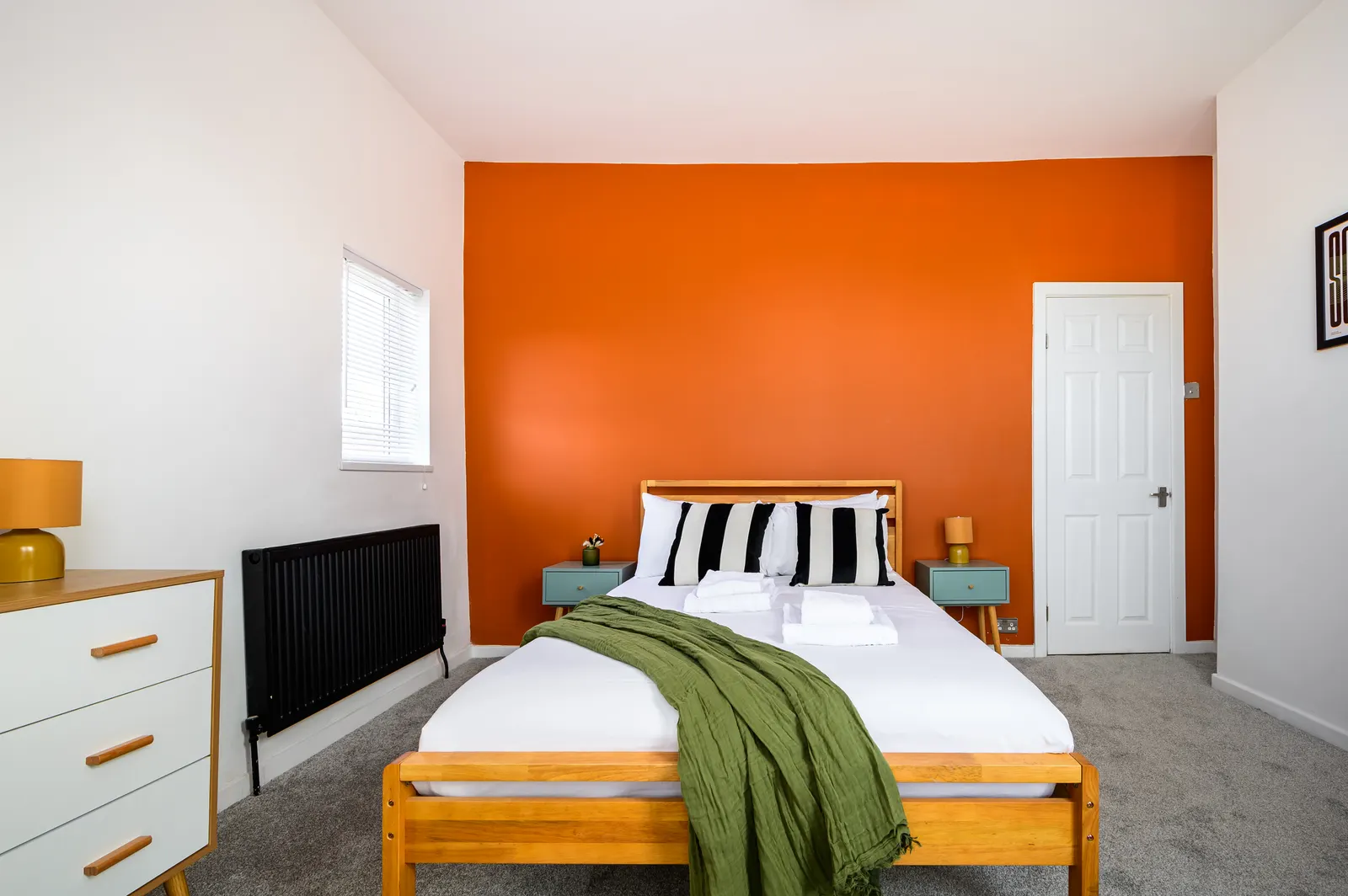
The house itself carries a distinct visual identity. When we took it on we fully funded a mid-range cosmetic refurbishment: new kitchen units and worktops, new laminate flooring throughout, feature walls in the living room and bedrooms, a new shower unit and tiling, new fixtures and fittings, and all new furniture. The result is character stock with a confident interior, including a bedroom the guests know as the Snooze Club and the Good Vibes living room. That styling is not decoration for its own sake. A property with a memorable identity pulls its own repeat bookings and stands out in a search results page full of identikit apartments.
Houses in this corridor punch above their weight for a simple structural reason. There are far fewer of them in the short-let market than there are apartments. Central Manchester has spent a decade building upward, so the supply of two-bed apartments in glass towers is deep and getting deeper. The supply of well-run three-bed houses within walking distance of the centre is thin. A three-bed house sleeps a group, suits a family, and houses a team of contractors in a way a one or two-bed apartment cannot. When demand for that shape of property arrives, and in Manchester it arrives constantly, there is very little competing stock to absorb it.
The demand pattern
The reason this house holds occupancy that most central apartments would envy is that it runs on a three-part demand engine, and the three parts rarely fall soft at the same time.
The first part is Manchester City. The Etihad is a short reach away, and every home fixture brings a wave of demand from supporters travelling in for the match, many of them in groups who want a whole house rather than a hotel room or a single apartment. A three-bed house is close to ideal for that guest. City play a long calendar of home games across the league and European competition, and each one is a predictable, high-value demand spike we can price for well in advance.
The second part is central-Manchester leisure. The city pulls a steady weekend crowd for concerts at the arenas, the Christmas Markets, festivals, stag and hen groups, and the general gravitational pull of a city centre that has become a genuine short-break destination. Rolls Crescent is close enough to all of it to sell as a city-centre stay, while offering something the centre cannot: a full house on a quiet street, at a price that undercuts three separate apartment bookings.
The third part is mid-term corporate. This is the piece that separates Rolls Crescent from a pure leisure play, and it is the reason the numbers hold through the quieter weeks. Manchester has a deep and constant flow of consultants, contractors, and project teams who need somewhere to stay for weeks or months rather than nights. A three-bed house suits a small team perfectly. Since December, an insurance company client has been booking the property continuously, which has delivered effectively 100 percent occupancy over that stretch and a renewal conversation now live for August. That is not the demand pattern of a central apartment chasing nightly leisure bookings. It is a different, steadier engine.
The important point is how these three overlap. When the football calendar quietens over an international break, the corporate booking is still running. When leisure softens in the depths of winter, a City home game or a contractor stay fills the gap. The three sources are not correlated, so the troughs do not line up. That is what produces occupancy that holds where a single-source apartment dips.
What we do operationally
The demand is there. Turning it into 95 percent occupancy and a fixed monthly cheque to the landlord is an operational job, and it runs on a specific spine.
Distribution is multi-platform. The house is listed and managed across Airbnb, Booking.com, and direct corporate channels, so it is never dependent on a single source of guests. That spread is what lets us capture leisure, football, and corporate demand at the same time, because each of those guests searches in a different place.
Pricing is dynamic and tuned to the Manchester calendar, with particular attention to Manchester City home fixtures at the Etihad. Match nights are priced deliberately and well in advance rather than left to a generic city average that would badly undersell them. Soft midweek stretches are priced to defend occupancy. The calendar works the demand rather than drifting with it.
The direct booking channel matters more for a property with a memorable identity than people expect. Guests who have stayed once, and corporate bookers who want to repeat a stay that worked, come back to us directly. That share of direct bookings lowers platform fees and builds the kind of repeat demand that a commodity apartment listing never generates.
Guest screening is rigorous, which matters more for a whole-house group let than for a single apartment. A three-bed house on a residential street is exactly the property where the wrong booking causes problems, so screening is not a box-tick. It protects the property, the neighbours, and the landlord relationship all at once.
Cleaning and turnovers are coordinated to house standards, which is a genuinely different job from an apartment turn. More rooms, more beds, more bathrooms, and tighter windows between a checkout and the next arrival. That coordination is professionalised rather than improvised, because a house that cannot be turned cleanly on a match weekend is a house that cannot capture match-weekend pricing.
The numbers
Here is what that operation produces on Rolls Crescent, and every figure below is drawn from the property’s own performance.
The owner receives their income, with a guaranteed minimum underneath it, arriving on the same date every month regardless of whether the house is full or empty. That is the point of the arrangement from his side. The occupancy risk sits entirely with us.
Across fourteen months of operation, the house has run at 95 percent occupancy. Set that against the UK serviced accommodation average, which sits closer to 65 percent, and the gap is the whole argument. This is a house a mile from the centre outperforming the occupancy of the average short-let by roughly thirty points.
The guest rating holds at 4.9 stars. High occupancy and a high rating tend to pull against each other, because the easy way to fill a calendar is to drop price and standards. Holding both at once is the signal that the operation is working rather than discounting its way to a full book.
Since December, the continuous corporate booking from the insurance company client has pushed occupancy to effectively 100 percent over that period, with a renewal under discussion for August. Corporate distribution of that kind stretches beyond the nightly short-let market into contract stays we can actually plan portfolio decisions around.
The landlord’s own words put it more plainly than the metrics:
Beyond Stays runs Rolls Crescent as if it were their own. The rent hits my account on the same date every month, the property is kept spotless, and I never get calls from tenants, repairs, or neighbours about guest issues. Exactly what I wanted from a property investment.
Nitin S., Landlord, Hulme, Manchester
What this proves about Hulme and character houses generally
The specific numbers belong to one house. The principle behind them is general. A character house in a walkable corridor, run by a strong operator, will frequently outperform a generic new-build apartment in an equivalent location. The reason is the three-part demand engine.
A new-build two-bed in a tower competes with hundreds of near-identical units for the same pool of leisure and corporate guests. It has no distinct identity, no group or family angle, and it prices into a crowd. A three-bed character house in Hulme competes with very little comparable stock, sells to football groups and families and corporate teams that apartments cannot serve, and carries an identity that earns repeat bookings. The house is not winning because Hulme beats the city centre on prestige. It is winning because scarcity, shape, and a diversified demand base combine into an occupancy profile that a commodity apartment structurally cannot match.
That is the operator’s take on why the corridor works: position close to the things that generate demand, in a property shape the market is short of, run on three demand sources that do not fall soft together.
What this pattern rules out
Honesty matters more than a clean story, so here is the other side. A house is not a soft option, and this pattern does not suit every landlord or every property.
Houses run on a different operational rhythm than apartments. Cleaning windows are tighter, because a three-bed group checkout and a same-day arrival is a bigger turn than a studio, and match weekends compress those windows further. Wear is heavier, because more guests through more rooms means more maintenance, and the refurbishment standard has to be maintained rather than left to decline. Family and group bookings need different guest management than a single business traveller in an apartment, from screening through to house rules and neighbour relations on a residential street.
None of that is a problem under a professional operation. All of it is a problem under a casual one. A landlord self-managing a whole-house short let, or handing it to an operator who treats it like an apartment, will feel every one of those frictions. The Rolls Crescent numbers are the output of an operation built for houses specifically. They are not a promise that any house, run any way, produces the same result.
Frequently asked questions
Why does a Hulme house outperform central Manchester apartments?
Scarcity and demand mix. There is little comparable three-bed house stock near the centre, and the house draws football groups, city-centre leisure, and mid-term corporate teams that apartments cannot serve. Three uncorrelated demand sources hold occupancy where a single-source apartment dips.
What occupancy and rating does Rolls Crescent achieve?
The house has run at 95 percent occupancy across fourteen months on a 4.9 star guest rating. Since December, a continuous corporate booking has pushed occupancy to effectively 100 percent over that period, against a UK serviced accommodation average nearer 65 percent.
How does the landlord get paid?
He receives his income on the same date every month, whether the house is full or empty. The occupancy risk sits entirely with Beyond Stays. The owner took a predictable monthly figure while the operational and demand risk sat with Beyond Stays.
What is the three-part demand engine?
Manchester City home fixtures at the nearby Etihad, central-Manchester leisure weekends, and mid-term corporate stays for consultants and contractors. Because the three sources are uncorrelated, their quiet periods rarely coincide, which is what keeps occupancy high through the year.
Is a house harder to run than an apartment?
Yes. Cleaning windows are tighter, wear is heavier, and group and family bookings need firmer screening and guest management. Run casually, those frictions bite. Run by an operation built for houses, they are simply part of the job and the numbers hold.
Can you do this with my Hulme or south Manchester property?
Very possibly, if the property has the right shape and position for the demand engine. We assess each property on its own merits. Talk to us about your Manchester property and we will tell you honestly what it can do.
Related reading
For where Hulme sits in the wider city picture, read the best areas in Manchester for short-let investment. For the numbers side of the argument, see what returns Manchester landlords can actually expect. And for the coordinated-block version of this same operating discipline, read how we transformed a Chinatown block.
You can see the underlying performance on our case studies page and the wider service on our management-only and Hulme property management pages. When you are ready, talk to us about your Manchester property.